AI Overviews and AI Mode: On Google, Search Is Becoming a Conversational Reflex
A study published in late July 2026 by Similarweb, The Evolution of AI Search, confirms that AI-generated summaries have become an almost systematic part of the Google search experience: in the United States, the share of queries triggering an AI Overview rose from 15% in January 2025 to 43% in May 2026. Over the same period, AI Mode, Google's conversational search interface, saw its active user base more than double, growing from 126 to 279 million between June 2025 and May 2026. Users are also writing increasingly long queries, phrased more like prompts, a shift driven by habits picked up from chatbots. While Google appears to be navigating this transition well — 95% of ChatGPT users still use the search engine alongside it — the trend is putting real pressure on publishers: the presence of an AI Overview is already estimated to cut the click-through rate of the top organic result by nearly 35%, a concern that is becoming very concrete now that AI Overviews and AI Mode have just rolled out in France.
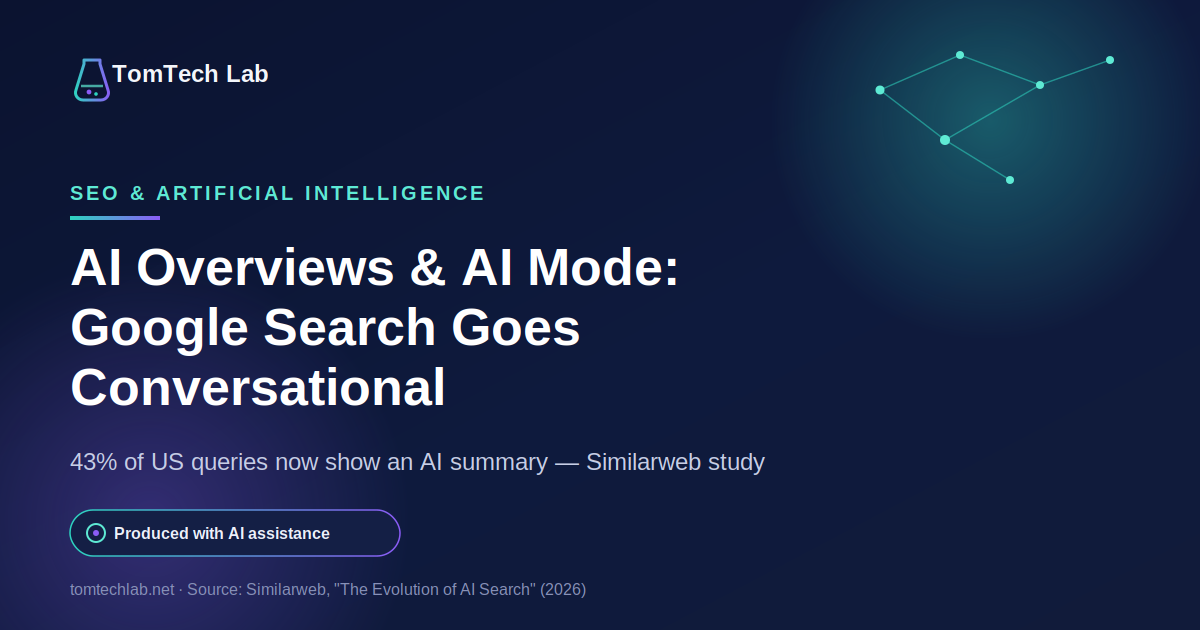
Is Google quietly turning its results page into a conversational interface? That's what a study published in late July 2026 by Similarweb, The Evolution of AI Search, suggests. The report analyzed the behavior of American users over sixteen months, and the finding is clear: AI-generated summaries are no longer an experimental feature — they have become an almost systematic step in the search journey.
43% of Queries Now Trigger an AI Summary
The most striking figure in the study concerns adoption: in the United States, the share of Google queries triggering an AI Overview rose from 15% in January 2025 to 43% in May 2026. In sixteen months, the frequency of these summaries has very nearly tripled.
Another strong signal: the number of active users of AI Mode, Google's conversational search interface, more than doubled between June 2025 and May 2026, growing from 126 to 279 million. Similarweb also notes a particularly fast tipping point right after AI Mode's rollout in the US market, between June and August 2025, when the share of queries including an AIO jumped from roughly 13% to 40% within a few weeks.
For Similarweb, this isn't a minor product tweak. The company describes a deliberate strategy in which AI Overviews mainly serve as an entry point toward a more conversational experience, working increasingly like a funnel: capture the user on the classic results page, then gradually steer them toward AI Mode.
Queries Are Getting Longer, More Like Prompts
The study documents a second, subtler but equally telling shift: the way people phrase their searches is changing. Between May 2025 and May 2026, the share of queries longer than five words rose from 13.6% to 16.1%, while very short queries (three words or fewer) declined slightly.
Similarweb's explanation is straightforward: habits picked up on chatbots are spilling over into traditional search. For years, users learned to compress their intent into a handful of keywords to "talk" to the search engine. As LLMs became capable of handling long, nuanced requests, that constraint is fading — people now type their searches the way they'd write a prompt.
The report also highlights different usage patterns across platforms. AI Mode tends to be used for quick answers, with short sessions averaging around 3 prompts. ChatGPT and Claude, by contrast, capture longer, more conversational exchanges, with 5 prompts or more per session. Another notable finding: as of May 2026, 95% of ChatGPT users still use Google alongside it, confirming that generative AI is expanding search behavior rather than replacing traditional search — at least for now.
Growing Pressure on Publisher Traffic
This shift isn't neutral for websites that rely on search traffic. Since AI Overviews launched in the US in May 2024, several studies have pointed to a mechanical drop in clicks to organic results whenever an AI summary appears at the top of the page. Ahrefs, for instance, measured as early as April 2025 that the click-through rate (CTR) of the top organic result dropped by roughly 35% when an AIO was displayed.
This dynamic is taking on particular weight in France, where AI Overviews and AI Mode have just been rolled out. Publishers and SEO teams will need to adapt to a search landscape where ranking first no longer guarantees the click — a large part of the answer may now be delivered directly inside the AI-generated summary.
What This Means for SEO and Content Marketing
This evolution confirms a trend many had already observed empirically: ranking well is no longer enough — content also needs to be accurately cited and summarized by generative AI. In practice, this reinforces the case for structuring content so it's easily extractable (clear answers, concrete figures, well-organized sections), while also building brand authority so a site remains a cited — and ideally visited — source, rather than an invisible link in the chain that produces the AI's answer.
Main source: Similarweb, The Evolution of AI Search (study published July 27, 2026), as reported by Blog du Modérateur. This article was produced with AI assistance (research, structuring and drafting assisted by Claude, reviewed and edited by Thomas).