Claude’s AI Marks: Fact vs Fiction on Watermarking and C2PA Provenance
Anthropic has signed the EU AI Act's Article 50 Code of Practice and now marks content generated by Claude. But between an invisible watermark, C2PA metadata, and uncovered older models, reality is more nuanced than most headlines suggest.

One question keeps coming up in generative AI discussions: how can you tell whether a piece of text, an image, or a file was produced by AI? Anthropic has published its official answer for Claude — and as often happens with this kind of announcement, it's been summarized, oversimplified, and sometimes distorted across social media and various articles. Between "everything Claude produces is now stamped" and "it's pointless since it's invisible anyway," the truth is more nuanced — and more interesting.
This article sets the record straight, based directly on Anthropic's official documentation, with the precise dates that actually matter.
The context: why Claude is marking content now
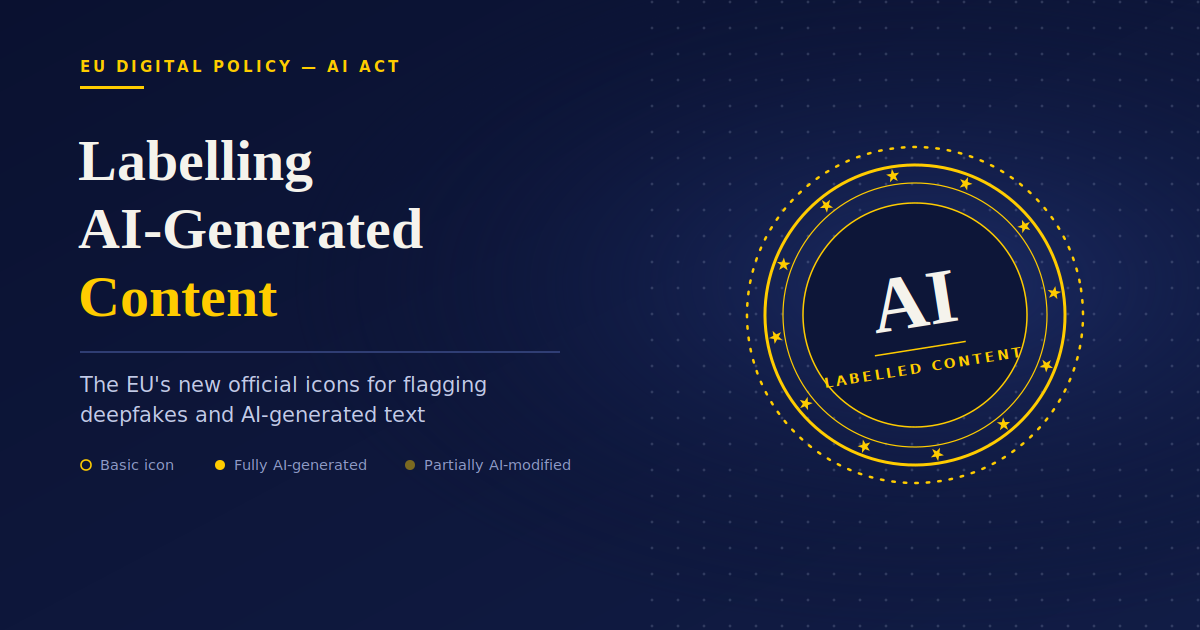
This isn't a purely voluntary Anthropic initiative. It stems from a European regulatory obligation: Article 50(2) of the EU AI Act, which requires providers of generative AI systems to make generated content identifiable in a machine-readable way. Anthropic signed the Code of Practice on Transparency of AI-Generated Content tied to this article, as a provider of both generative AI models and generative AI systems.
In practical terms, Claude's marking isn't a marketing gimmick — it's legal compliance, with a specific timeline and technical limitations that Anthropic itself openly acknowledges.
The two techniques Claude uses
Anthropic distinguishes two complementary mechanisms, and this is the first point that's often blurred in secondary summaries.
1. Embedded watermark in text
When a supported Claude model generates text, a watermark is woven directly into the text itself, at the token-generation level. It's completely imperceptible: it doesn't change the meaning, quality, or readability of the response. Because it's part of the text itself, it travels along when the text is copied and pasted, and can survive some editing to a degree. This watermark is applied at the model level, so it's present regardless of which Claude product or interface generated that text (Claude.ai, the API, Claude Code, and so on).
2. Signed provenance metadata
For generated files (for example .svg, .png, or .jpg), Claude can attach signed provenance metadata following the open C2PA standard (Coalition for Content Provenance and Authenticity), already widely used across the industry. This metadata signals that a file was processed by Claude and lets you detect whether it's been tampered with since.
Two mechanisms, two different uses: a watermark for generated text, provenance metadata for files.
The exact timeline — and why it changes everything
This is where most of the misconceptions come from, because the date matters enormously.
Models launched in the EU on or after August 2, 2026 support machine-readable marking from launch. Generated text carries an embedded watermark, and supported files receive signed provenance metadata.
Models launched before August 2, 2026 aren't automatically covered. The law includes a transition period for these models, and Anthropic states it's working to add marking support for them too — but this isn't yet guaranteed or generalized at the time of writing.
In other words: as of August 15, 2026, this regulatory shift is very recent. If you used Claude before that date, or you're still using an earlier model, you shouldn't assume the content produced is marked.
Where it applies (and where it might not)
Marking covers output from supported models across all Claude products: Claude Platform (API), Claude (the consumer app), Claude Code, Claude Cowork, and Claude Tag, and this applies wherever Claude is offered worldwide — not just in the EU.
On the cloud partner side, the text watermark applies when supported Claude models are accessed through AWS, Google Cloud, or Microsoft Foundry. However, signed provenance metadata isn't necessarily available on every one of these platforms — it depends on the features each one supports.
Finally, detection by users and third parties is described as work in progress: Anthropic promises forthcoming technical documentation, but no detailed public detection tool is described on the official page as of this writing.
Debunking: the myths currently circulating
❌ "Everything Claude generates is now watermarked"
False, or at least incomplete. Only models launched in the EU on or after August 2, 2026 mark their output from launch. Earlier models aren't automatically covered — marking for them is "in progress," not universal.
❌ "You can see the watermark in the text"
False. The watermark is explicitly described as imperceptible. It doesn't alter the visible form or content of the text; it's a statistical signal embedded during generation, not a visible tag or graphical stamp.
❌ "If no watermark is detected, it wasn't AI-generated"
False — and probably the most dangerous confusion of all. Anthropic is explicit on this: a lack of detected mark proves nothing. Content might have been generated by a model that predates marking coverage, been heavily edited, paraphrased, or translated, be too short for a reliable signal, or have lost its metadata through a format conversion, re-save, or screenshot.
❌ "Detecting Claude's mark proves the content is entirely AI-authored"
False in the other direction too. A detected mark signals that content may have been processed by Claude — not that Claude is its original author. A common Claude use case is proofreading, translating, summarizing, or converting content that already exists: the output can carry the mark even though the underlying ideas, text, or data came from elsewhere. Marked content can also have been modified, excerpted, or combined with other material after Claude processed it.
❌ "This only applies to text"
False. Supported file types (notably SVG, PNG, and JPG) receive signed provenance metadata following the C2PA standard, independently of the text watermark.
❌ "A public detection tool is already available"
Not yet, as of now. Anthropic states it wants to support detection by users and third parties, but points to forthcoming technical documentation. So don't expect a ready-to-use public verifier just yet.
The limitations, openly acknowledged by Anthropic
What makes this announcement credible is precisely that Anthropic doesn't present it as a perfect solution. Two structural limitations are stated explicitly:
A detected mark isn't fully conclusive. It indicates content may have been processed by Claude, without confirming the entire provenance chain on its own (original authorship, subsequent edits, and so on).
The absence of a mark doesn't prove the absence of AI generation. An uncovered model, heavy editing, a passage that's too short, lost metadata, an unsupported feature: there are many reasons for nothing to be detected, even on content that was genuinely generated by Claude.
For anyone who, like in e-commerce or SEO, has to assess the reliability of content (customer reviews, product listings, articles), this point is worth repeating: marking is a decision-support signal, not absolute proof.
If you're building with Claude
Anthropic reminds businesses deploying Claude in their own products or services that they must independently assess what Article 50 requires of them for their own transparency obligations. Anthropic's marking is a support for that compliance — not an automatic substitute for each deployer's own legal analysis.
In summary
The marking of Claude-generated content is real and technically serious (an imperceptible text watermark plus C2PA metadata on files), and it's directly tied to a European legal obligation that took effect on August 2, 2026. But it isn't universal (models predating that date aren't automatically covered), isn't foolproof (no mark ≠ no AI, detected mark ≠ full proof of provenance), and isn't yet directly verifiable by the general public (detection tools are still described as "forthcoming").
In short: a genuine step forward for transparency, but not the magic-bullet solution some media shortcuts suggest.
Official source: Claude Help Center — How Claude marks AI-generated content (page accessed and up to date as of August 15, 2026).