AI Overviews Land in France: What It Means for Your Product Pages
Google launched AI Overviews in France on 22 July 2026. Drawing on two years of feedback from the US, this article analyses the actual impact on e-commerce traffic: product pages are largely unaffected, but all informational content — buying guides, comparison features and blog posts — is on the front line
On July 22, 2026, Google switched on AI Overviews and AI Mode in France. After two years of testing in the US and roughly a hundred other countries, French e-commerce sites are now getting their first taste of these AI-generated summaries that appear at the very top of search results, above the first organic listing.
For a content site or blog, this is already a sensitive topic. For an e-commerce site, it's doubly so: every point of organic traffic lost on a product page or category page translates directly into lost revenue. Here's what the American experience lets us anticipate, and more importantly, what can actually be done at the scale of an online store.
Informational traffic takes the hit, transactional traffic holds up (for now)
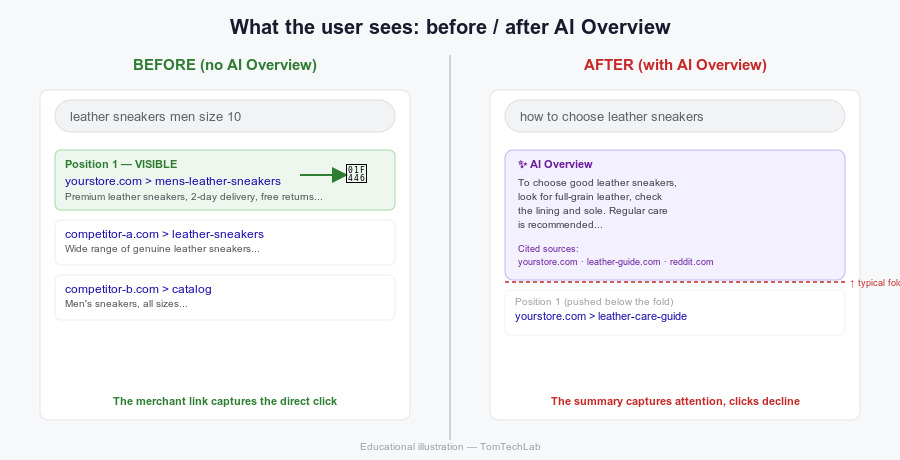
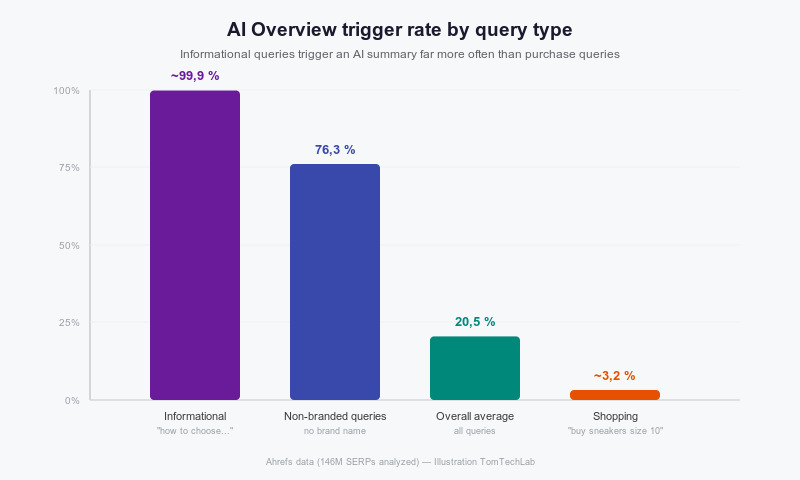
Every US study agrees on one point: click-through drops sharply once an AI summary appears, sometimes by half. But this drop isn't evenly distributed across query types. Data compiled by Ahrefs across more than 140 million search results pages shows that AI Overviews trigger almost exclusively on informational queries, while the trigger rate for shopping-type queries falls to around 3%.
In practice, this means:
a query like "how to clean leather sneakers" is very likely to generate an AI summary
a query like "buy men's leather sneakers size 10" mostly avoids it, since Google still favors classic shopping results (Google Shopping, product listing ads, merchant organic results)
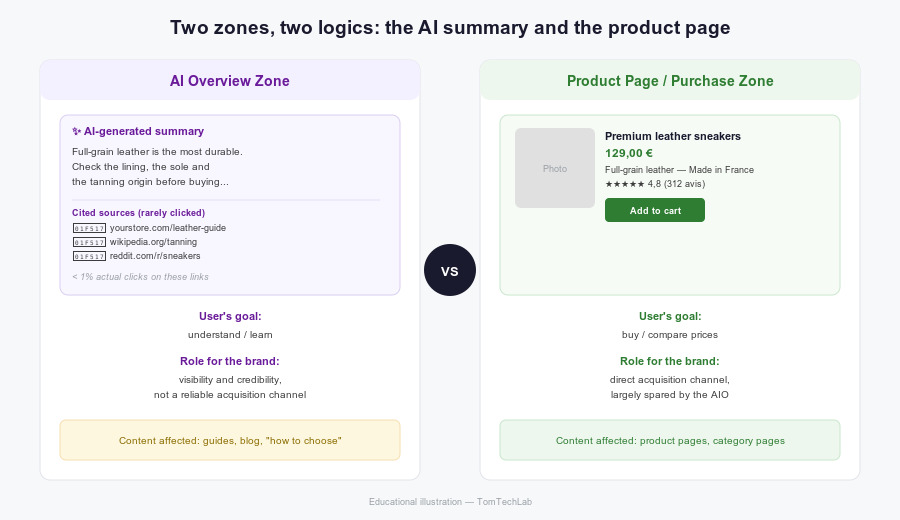
The good news: your product pages built around pure purchase intent remain largely spared. The less good news: all your blog content, buying guides, comparisons, and "how to choose" pages — often the main SEO traffic driver for an e-commerce site outside of product pages themselves — is on the front line.
Positions 1 and 2 lose the most — worth watching on your buying guides
A study by agency GrowthSRC covering 200,000 keywords measured a sharp drop in click-through rate on the very first organic position, with a diminishing effect down through positions 4–5. Conversely, lower-ranked positions (5 to 10) regain some of that traffic, as users scroll further down looking for a more complete answer when the summary doesn't satisfy them.
For an e-commerce site, this finding is worth watching closely on buying-guide, comparison, or tutorial content tied to your products: if one of these pages was ranking #1 or #2 on a high-volume query, that's probably where you'll feel the first traffic hit. A page ranking #6 or #7, paradoxically, has more breathing room.
Being cited in the AIO isn't a silver bullet
Another lesson worth keeping in mind before chasing "AIO citation" as an optimization goal: according to Pew Research Center, fewer than 1% of users actually click through on the links offered inside an AI Overview. Being visible in the summary doesn't make up for the loss of classic organic clicks — it's a brand-visibility bonus, not a reliable acquisition channel.
That said, for pages that do perform well within AIOs, Terakeet observed a different effect depending on intent: transactional pages cited in a summary can see their residual traffic multiply several times over compared to a citation on a purely informational page. The sample size calls for caution, but the signal points the same direction as everything else: purchase-oriented content gets treated differently.
What you can put in place right now
Segment your GA4 tracking by page type. Before drawing broad conclusions about "traffic going down," separate product pages, category pages, and editorial content (blog, guides). The trends are unlikely to be the same.
Watch CTR by position in Search Console, especially on your buying guides ranking positions 1–3, which are statistically the most exposed.
Don't sacrifice informational content, even if it becomes less profitable in direct clicks — it still acts as a trust and authority signal that can influence AIO citation, and drives traffic on channels like Reddit or YouTube, which are clicked more often according to available UX studies.
Reassess the role of direct shopping traffic (Google Shopping, comparison sites, social channels) in your acquisition mix, rather than relying solely on informational SEO to bring visitors to the product page.
AI Overviews are redistributing attention at the top of the results page, but e-commerce isn't affected uniformly: purchase-intent queries remain, for now, largely spared, unlike the informational content orbiting the product catalog. The real question for the coming months isn't "will I lose traffic?" but "how much of my current informational traffic actually converts, and is it worth defending against AI — or should that budget be reallocated elsewhere?"