Labelling AI-Generated Content: The EU's New Official Icons
The European Commission has released a set of official icons (downloadable in SVG/PNG, 4 colour variants) to flag content generated or manipulated by AI, in support of Article 50 of the AI Act. Three distinct pictograms cover: general AI involvement, content that is fully AI-generated, and content that is partially modified by AI. Using the icon is optional, but the transparency obligation itself is not.
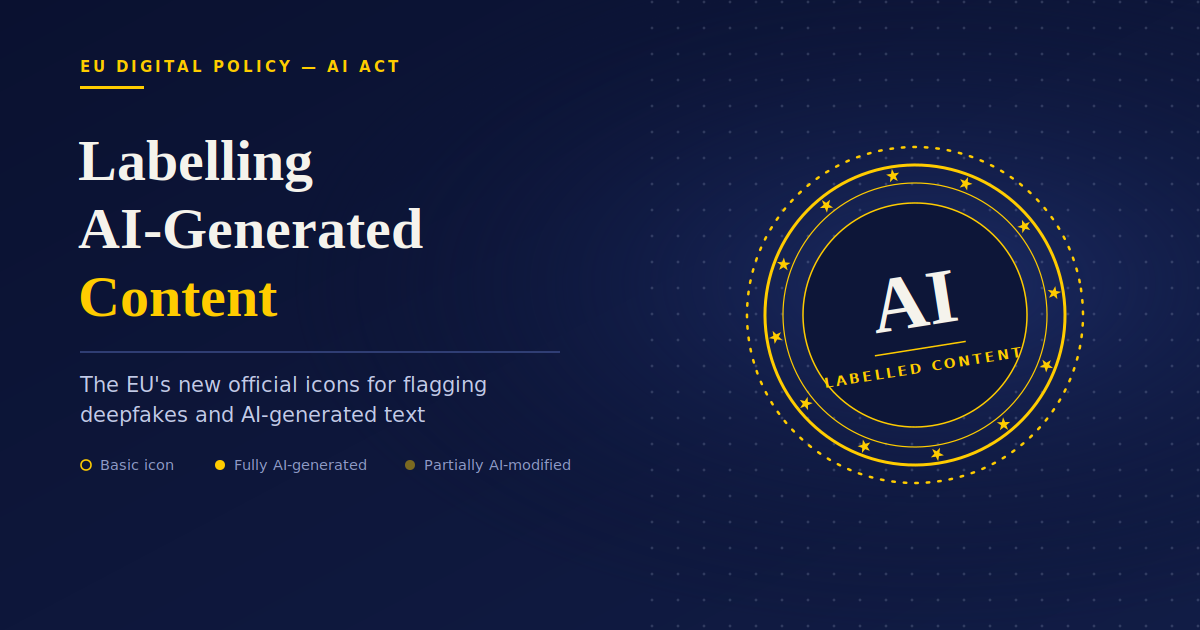
An icon to make AI visible
The European Commission has released a set of official icons designed to label content generated or manipulated by artificial intelligence. The initiative builds on the Code of Practice on marking and labelling of AI-generated content, which itself supports the transparency obligations of the AI Act (Article 50).
The goal is straightforward but strategically significant: allow any person exposed to a piece of content — image, video, audio, or text — to immediately recognise whether what they are seeing or reading was produced or altered by generative AI, with no risk of mistaking it for authentic content.
What content needs to be labelled?
Not every AI-assisted creation falls under this obligation. The rules precisely cover two categories:
Deepfakes: AI-generated or manipulated images, audio, or video that resemble real people, objects, places, or events closely enough that they could be mistaken for authentic.
AI-generated or manipulated text published to inform the public on matters of public interest, where the content has not undergone human review and no natural or legal person has assumed editorial responsibility for it.
In practice, this means an article drafted with AI assistance but reviewed and approved by an accountable editor falls outside the labelling requirement — an important nuance for newsrooms and marketing teams that use generative tools day to day.
The exceptions
Three scenarios ease or remove the disclosure obligation:
Evidently artistic, creative, satirical, or fictional works: where a deepfake is clearly part of a creative or satirical work, disclosure only needs to be made "in an appropriate manner" that does not hamper the display or enjoyment of the work.
Uses authorised by law: notably for detecting, preventing, investigating, or prosecuting criminal offences.
Text that has undergone human review, with editorial responsibility assumed by a natural or legal person.
Three icons, three levels of AI involvement
The Commission's icon set distinguishes three situations, each tied to a downloadable pictogram available in four variants (black, white, and 50%-transparent versions of each), in both SVG and PNG formats:
Icon | When to use it | Example use cases |
|---|---|---|
Basic icon | AI was involved in creating deepfake content (image, audio, video) or published text, or when a custom text label or interactive second layer is used | A deepfake video labelled "voice generated with" followed by the icon |
Fully AI-Generated | The entire piece of deepfake content (image, audio, video) or text is fully AI-generated, with no human-created elements beyond prompting | Fully AI-generated deepfake videos featuring politicians or fictional events; fully AI-composed music or art; AI-generated news summaries |
Partially AI-Modified | Pre-existing, human-made content was partially modified with AI, turning it into a deepfake or into text on matters of public interest | A face swapped for a politician's in an authentic photograph using AI; an empty apartment furnished with AI in an otherwise authentic photo |
Worth noting: user testing found that performance improved across the board when the basic icon was paired with a text label (e.g. "modified"), rather than used on its own.
How should the icons be displayed?
The guidance sets out a baseline of placement rules (the full detail sits in the Code of Practice):
The icon must be clearly perceivable at the latest by the time a person is first exposed to the content.
It must be placed where no overlay elements obscure it.
It should be directly embedded in the deepfake or published text (except for creative works), unless an equivalent alternative such as a user-interface overlay is available; it must remain visible when the content is reshared or downloaded.
Accessibility recommendations round out the framework: a clearly visible size, plain-language labels free of jargon (aside from the abbreviation "AI"), compatibility with assistive technologies (alt text, ARIA labels), sufficient display time for users with cognitive or processing difficulties, and a clear indication when an interactive second layer offers further information.
Optional to use, but the legal obligation is not
An important point for any product, marketing, or legal lead: using these icons is optional, but the transparency obligation under Article 50 of the AI Act is not. Displaying the official icon does not, on its own, guarantee legal compliance — deployers remain fully responsible for ensuring their disclosure meets the AI Act's requirements. Signatories of the Code of Practice also commit to properly implementing its placement specifications.
On licensing, the icons are made available free of charge and without any requirement to credit the Commission or the AI Office — a welcome detail for broad adoption. The Commission notes, however, that use of the icons by a non-signatory of the Code should not be read as a signal that the organisation adheres to it.
What this means for e-commerce and marketing teams
For any organisation producing or distributing content — AI-retouched product visuals, auto-generated product descriptions, ad videos with synthetic voices or faces — this framework offers a shared visual vocabulary and a concrete starting point for building an internal labelling policy, useful well beyond regulatory compliance, as a matter of building customer trust.
Source: European Commission, Directorate-General for Communications Networks, Content and Technology (DG CONNECT) — last updated 10 June 2026.


