MAI-Cyber-1-Flash: Microsoft Bets on AI to Industrialize Cybersecurity
Microsoft has launched MAI-Cyber-1-Flash, its first cybersecurity-focused AI model, integrated into MDASH. By pairing this compact model (handling 90% of tasks) with heavier models for edge cases, Microsoft claims a 96% score on the CyberGym benchmark while cutting costs by 50%. The announcement also introduces Perception, an agentic system for continuous threat monitoring. A concrete illustration of smart model-routing based on task complexity.
MAI-Cyber-1-Flash: Microsoft Bets on AI to Industrialize Cybersecurity
On July 27, 2026, Microsoft AI unveiled MAI-Cyber-1-Flash, its first AI model dedicated to cybersecurity, integrated into MDASH (its multi-agent vulnerability identification and remediation harness). The headline claim: state-of-the-art performance at half the cost of leading competing models.
The context: an arms race between attackers and defenders
Microsoft's framing is straightforward: generative AI has collapsed the cost of finding vulnerabilities for attackers, who can now scan entire codebases for a single weak point. Against this backdrop, the traditional security model — scan occasionally, patch eventually — is no longer sustainable. Microsoft's answer is to fight AI with AI.
A model built for efficiency, not just raw power
What stands out in this announcement is less the raw benchmark score than the economic strategy behind it. MAI-Cyber-1-Flash is a compact, code-heavy model derived from the MAI-Thinking-1 lineage, designed to handle up to 90% of routine detection tasks on its own. The remaining 10% — the hardest cases — are routed to larger, more expensive models (currently GPT-5.4 within the MDASH architecture).
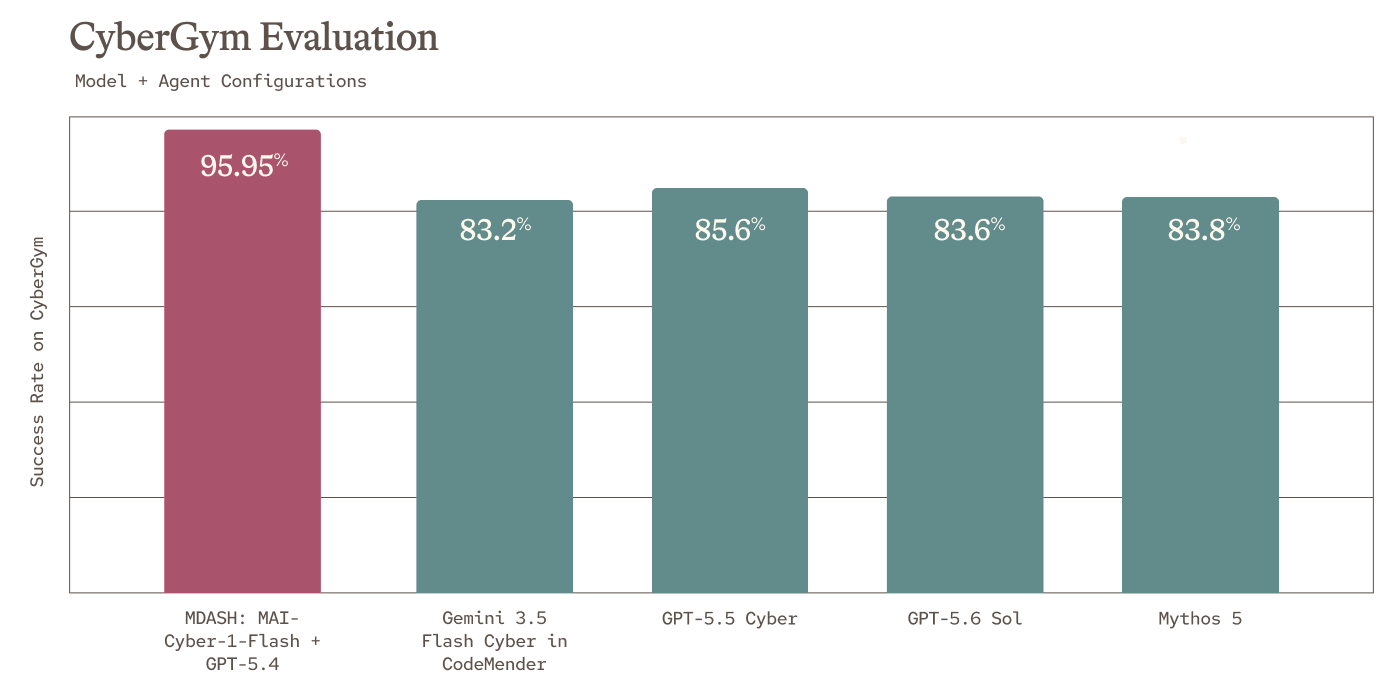
This intelligent task-routing approach reportedly delivers a 95.95% score on CyberGym — the reference benchmark for evaluating how well a system reasons over complex codebases to find real vulnerabilities — while cutting costs by 50% compared to MDASH's previous setup (which combined GPT-5.4, 5.4 mini, and 5.3 codex). That's a 12-point lead over Mythos, the model cited as the main point of comparison.
This is a useful lesson for anyone designing AI-driven automation systems: the most powerful model isn't always the right choice for every task. Routing intelligently to the cheapest model capable of handling a given problem, and reserving the premium model only for genuinely hard cases, is a logic that extends well beyond cybersecurity — including into much smaller-scale automation setups.
Three pillars: model, data, harness
Microsoft frames its case around three elements it considers inseparable:
The model: MAI-Cyber-1-Flash, trained in-house on high-quality data.
The data: decades of security signals across identity, endpoint, cloud, and network, with a claimed volume of over 100 trillion signals per day and a track record of real exploits and remediations Microsoft argues is impossible to replicate.
The harness: MDASH itself, a system built around 100+ specialized agents, each tuned by security experts to find, validate, and remediate vulnerabilities.
Microsoft is also launching Perception, an agentic security system for continuous monitoring and closing new threat vectors, which is expected to gradually adopt MAI-Cyber-1-Flash as well.
Security and governance
Microsoft emphasizes that the model went through internal Red Team evaluation, automated and expert-led adversarial testing, and an independent third-party assessment. At the platform level, MDASH offers role-based access control, tenant isolation, encryption, auditability, and sandboxed execution environments with no internet access — the kind of guarantees enterprise customers expect.
Key takeaway
Beyond the marketing appeal of benchmark numbers, this announcement reflects a broader trend: cybersecurity is becoming a prime application area for agentic AI, where the "detect → validate → remediate" loop is increasingly automated end to end. For anyone working in digital or e-commerce, this raises a concrete question: how will these tools reshape the way security audits and vulnerability management get integrated into product development cycles, especially for platforms handling sensitive customer data.
Source: Microsoft AI — Introducing MAI-Cyber-1-Flash inside MDASH, July 27, 2026.